
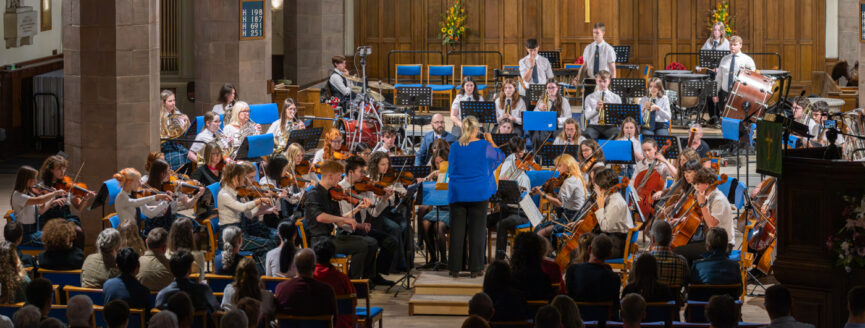
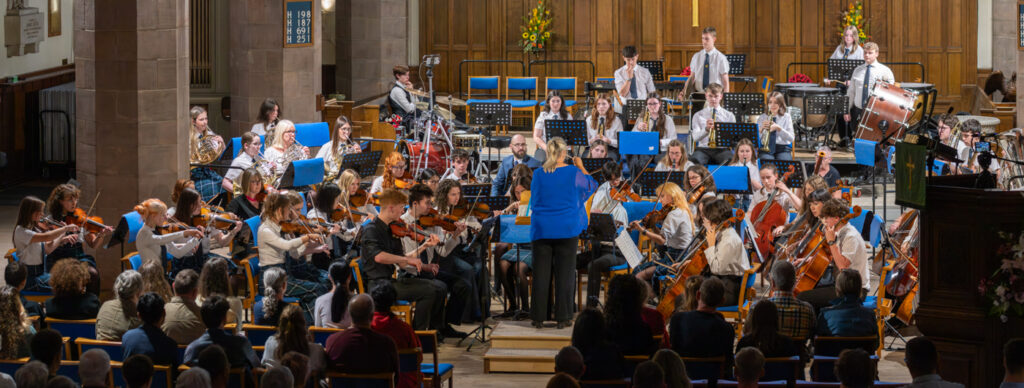
There are few settings better suited to the sweep and colour of a youth orchestra than Greyfriars Kirk, and Perth Youth Orchestra’s latest Edinburgh Fringe appearance offered an engaging reminder of why the ensemble has become such a regular and welcome presence at the festival.
Under conductor Lorna McGovern, PYO presented a varied programme spanning Sibelius and Brahms to Britten, Copland and contemporary concert-band repertoire. It was a concert that celebrated not only the collective strength of the orchestra but one of its finest traditions: giving outstanding young musicians from within its own ranks the opportunity to step forward as soloists.
The concert opened with Sibelius’s Finlandia, an inspired choice for the resonant acoustic of Greyfriars. Its dark opening sonorities gave way to music of increasing urgency and grandeur, establishing from the outset the scale of sound this young orchestra can produce. Yet the performance was not simply about volume. McGovern maintained a firm sense of direction, allowing the familiar hymn-like theme to emerge with warmth and dignity.
Then came the first of the evening’s featured young musicians. Joe Rogers, a 17-year-old trumpeter from the Community School of Auchterarder, was the soloist in the second movement of Haydn’s Trumpet Concerto in E-flat major. He has grown up musically through school and regional ensembles and recently won his local Rotary Young Musician competition. His Haydn provided an attractive contrast to the weight of Sibelius: poised, lyrical and cleanly shaped, with the orchestra proving an attentive partner.
PYO has a long-established tradition of selecting soloists from among its own players, affording generations of young musicians a platform on which to demonstrate their remarkable talent. It is an admirable principle: the solo spot is not something imported into the orchestra but something towards which its members can aspire.
Britten’s Simple Symphony followed, represented by the third movement, the Sentimental Sarabande. Its combination of youthful directness and unmistakably sophisticated writing made it particularly apt for a youth orchestra. The strings responded to its long lines with concentration and an appealing seriousness.
The second soloist, Finlay Rutherford, then took centre stage for Vittorio Monti’s irrepressible Czardas. Finlay is a pupil at Kinross High School, leader of PYO, and a strikingly versatile young musician. As well as classical violin, his musical life encompasses traditional music, guitar, percussion and jazz. That breadth seemed entirely at home in Czardas, a piece requiring the soloist to move rapidly between introspection, swagger and outright virtuosity. He embraced its theatricality, dispatching its changes of mood and pace with considerable flair, particularly through the etherial harmonic passages.
The first half closed on a grand scale with the fourth movement of Brahms’s First Symphony, in an arrangement by Vernon Leidig. It was a substantial test after an already demanding programme, but it also showed what PYO does particularly well: young players committing themselves wholeheartedly to major repertoire and discovering the exhilaration of producing a genuinely orchestral sound together.
The President’s welcome in the programme described 2025/26 as a “very successful” session and invited the audience to “sit back” and enjoy the orchestra. There was good reason for that confidence. The welcome also recalled PYO’s collaboration during the year with the Waunakee School Orchestra from Wisconsin — an encounter highlighting “cooperation and respect” alongside the musical abilities of both orchestras.
After the interval, the mood changed decisively with R. W. Smith’s Into the Storm, before Copland’s Hoedown brought some unmistakably American energy to Greyfriars, in Stephen Bulla’s arrangement for strings and percussion. Its snapping rhythms and open-air exuberance made it an effective showcase for ensemble precision.
Brian Balmages’s Opening Night maintained the energy. PYO’s young musicians moved seamlessly between classical symphonic writing, virtuoso showpieces, American vernacular influences and lighter concert repertoire.
A fire lit up as the young musicians struke up Satchmo – A Tribute to Louis Armstrong, arranged by Ted Ricketts. It carried particular poignancy through a timely dedication following the death of Dolly Parton. It was a fitting tribute to a lady whose life was marked not only by music but by an enduring commitment to opening doors for young people and nurturing their hopes for the future.
The programme reached a warmly Scottish conclusion with Loch Lomond, in Andrew Duncan’s arrangement and featuring Dougal Stewart as soloist. At an Edinburgh Fringe concert, the familiar melody inevitably carries an additional resonance, and it provided an affectionate conclusion to an evening rooted in both place and community – it sounds drowning the opening salvo at the nearby Edinburgh Military Tattoo.
For Perth Youth Orchestra, appearing at the Fringe is no novelty. The orchestra are regular Fringe performers, and that continuity matters. Bringing a youth orchestra to Edinburgh gives its members the experience of performing amid one of the world’s great international festivals while allowing Fringe audiences to hear the quality of music-making being nurtured among young players in Perth and Kinross.
There was, too, a sense at Greyfriars of an orchestra looking beyond the end of one successful season towards the next chapter. In the coming year PYO will return to its customary cycle of European concert touring, with Belgium the destination. Such tours have long been an important part of the orchestra’s identity, combining demanding performances with the wider cultural and social experience that makes membership of a youth orchestra about considerably more than rehearsals and concerts.
That wider purpose was evident throughout this Fringe appearance. PYO’s achievement lies not merely in teaching young people to play difficult music well. It gives them the chance to lead, to accompany one another, to take responsibility within an ensemble and, in the case of musicians such as Rogers and Rutherford, to walk out from their accustomed place among their colleagues and command the stage as soloists.
At Greyfriars Kirk, those individual achievements were impressive. More impressive still was the supportive musical community surrounding them. Perth Youth Orchestra continues to demonstrate that a youth orchestra can be both a training ground and a serious performing ensemble — ambitious for its players, generous in the opportunities it gives them, and capable of sending an Edinburgh Fringe audience away with a strong sense of the remarkable musical talent of the next generation.